
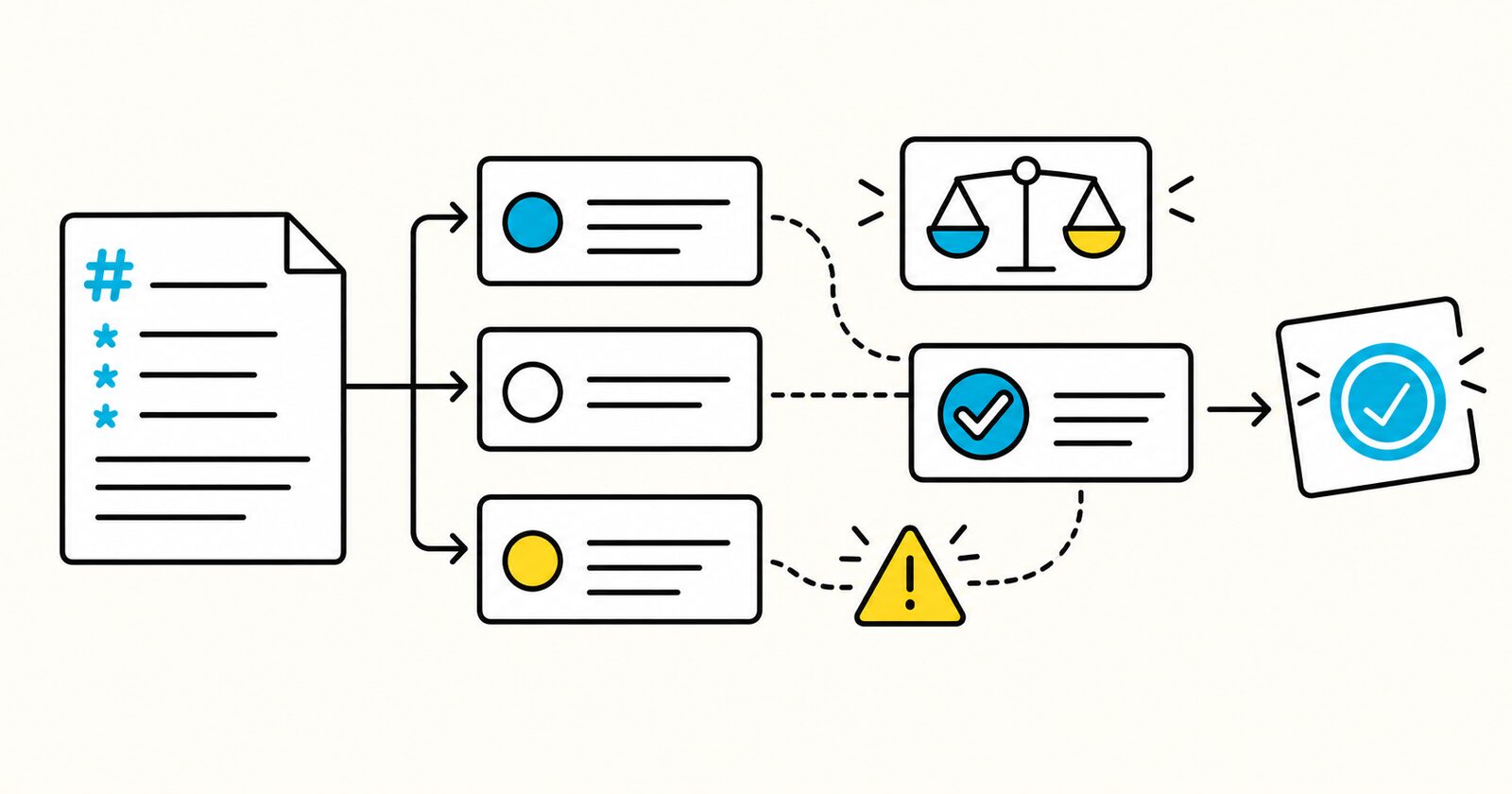
The document should make the approval request clear on the first page. Detailed calculations and evidence can sit in linked appendices.
Business case at a glance
| Section | Question answered |
|---|---|
| Executive summary | What decision is requested, and what is recommended? |
| Problem or opportunity | What is happening now, based on evidence? |
| Cost of doing nothing | What happens if no change is approved? |
| Options | Which feasible choices were compared consistently? |
| Costs and benefits | What value is expected, over what period, and with what confidence? |
| Risks and sensitivity | Which assumptions could change the conclusion? |
| Delivery | Who owns implementation and benefit tracking? |
| Approval | Who decided what, when, and under which conditions? |
Copyable Markdown business case template
# Business case: [Initiative]

**Sponsor:** [Name]
**Status:** Draft / For decision / Approved / Rejected
**Decision required by:** YYYY-MM-DD

## Executive summary
- **Decision requested:** [Request]
- **Recommended option:** [Option]
- **Investment:** [Cost]
- **Expected benefit:** [Outcome and timing]
- **Main risk:** [Risk]

## Problem or opportunity
[Evidence-based current situation.]

## Options considered
| Option | Description | Cost | Benefit | Time | Risk | Feasibility |
|---|---|---:|---:|---|---|---|
| 0 | Do nothing | [Value] | [Value] | [Time] | [Risk] | [Assessment] |
| 1 | [Option] | [Value] | [Value] | [Time] | [Risk] | [Assessment] |

## Costs
| Cost | One-time | Recurring | Internal effort | Confidence | Source |
|---|---:|---:|---:|---|---|
| [Item] | [Value] | [Value] | [Hours] | Low/Medium/High | [Source] |

## Benefits
| Benefit | Baseline | Target | Value | Owner | Date | Method |
|---|---:|---:|---:|---|---|---|
| [Benefit] | [Value] | [Value] | [Value] | [Name] | YYYY-MM-DD | [Method] |

## Risks and sensitivities
| Variable | Base assumption | Downside case | Impact | Response |
|---|---|---|---|---|
| [Variable] | [Value] | [Value] | [Effect] | [Action] |

## Decision
| Approver | Decision | Date | Conditions |
|---|---|---|---|
| [Name] | Approve / Reject / Revise | YYYY-MM-DD | [Conditions] |
What should a business case include?
A business case should include the decision request, current baseline, consequence of doing nothing, strategic objective, feasible options, recommendation, costs, benefits, risks, assumptions, delivery outline, and approval.
The options should be comparable. Use the same evaluation period and assumptions for cost, benefit, time, feasibility, and risk.
Start with the decision
Write the executive summary last, but place it first.
An approver should understand:
- what they are being asked to approve;
- the recommended option;
- total and recurring cost;
- expected benefit and timing;
- the largest uncertainty;
- what happens next.
Avoid opening with several pages of organizational history.
Establish the baseline
Quantify the current problem or opportunity before describing a solution.
Useful baseline evidence can include cost, time, error rate, delay, customer behavior, missed revenue, operational risk, or regulatory exposure.
Also describe the “do nothing” forecast. Doing nothing is not always free. It may preserve current operating cost, delay, or risk.
Compare at least three options where practical
A credible case normally includes:
- continue the current approach;
- a lower-cost or narrower alternative;
- the recommended option.
Larger cases may include additional buy, build, partner, or phased options.
Do not create obviously weak alternatives merely to make the preferred choice look better.
Separate costs, benefits, and assumptions
Include one-time and recurring costs. Count internal effort when it materially affects capacity.
For every benefit, name:
- the baseline;
- the target;
- the value or outcome;
- the benefit owner;
- the measurement method and date.
Label assumptions and sources. A forecast is not a fact because it appears in a table.
Test the conclusion with a downside case
Change the assumptions most likely to affect the decision: adoption, price, delivery time, volume, savings rate, or benefit timing.
If a small change makes the preferred option unattractive, the approver needs to see that sensitivity.
Completed business-case example
## Decision requested
Approve a six-month pilot of automated invoice matching for two business units, capped at S$80,000.

## Baseline
- 1,200 staff hours per quarter spent reconciling invoice exceptions.
- 3.8% of invoices require rework after initial review.

## Options
| Option | Cost | Expected benefit | Main risk |
|---|---:|---:|---|
| Continue manual process | S$0 project cost | No improvement | Cost grows with volume |
| Improve rules in current system | S$25,000 | 15–20% fewer manual checks | Limited exception coverage |
| Six-month pilot | S$80,000 cap | 35–45% fewer manual checks | Adoption and integration effort |
The example describes a bounded decision and makes the baseline and alternatives visible.
Business case versus project plan
A business case answers whether an investment should proceed and which option is justified.
A project plan explains how the approved option will be delivered. Do not hide an uncertain investment decision inside a delivery plan.
Common business-case mistakes
- Beginning with a preferred solution rather than the problem and baseline.
- Omitting the do-nothing option.
- Comparing options using different assumptions.
- Counting soft benefits as guaranteed cash savings.
- Ignoring internal effort and recurring cost.
- Presenting one forecast without sensitivity analysis.
- Naming benefits without owners or measurement dates.
- Burying the decision request near the end.
Business case FAQ
What are the main parts of a business case?
Executive summary, problem or opportunity, baseline, options, recommendation, costs, benefits, risks, delivery outline, and approval.
Is a business case the same as a proposal?
A proposal may describe an offered solution or service. A business case is the buyer or sponsor’s evidence-based decision document comparing options and expected value.
Should a business case include a do-nothing option?
Yes, in most cases. It establishes the baseline and shows the cost, benefit, and risk of continuing the current approach.
How do I calculate ROI?
A basic formula is ((total benefit - total cost) / total cost) × 100. Use an agreed evaluation period and validate the method with finance. Complex investments may require discounted cash flow or other methods.
Who owns the benefits after approval?
Name a benefit owner for each material outcome. The project owner may deliver the change, but an operational owner often remains accountable for realizing and measuring the benefit.
Related templates
- Project brief template
- Project plan template
- Risk register template
- Decision log template
- All Markdown templates
Sources
Validate financial calculations and decision requirements with the appropriate finance, procurement, legal, and governance teams.