Its job is to give the creative team enough direction to make good decisions without turning the brief into a script.
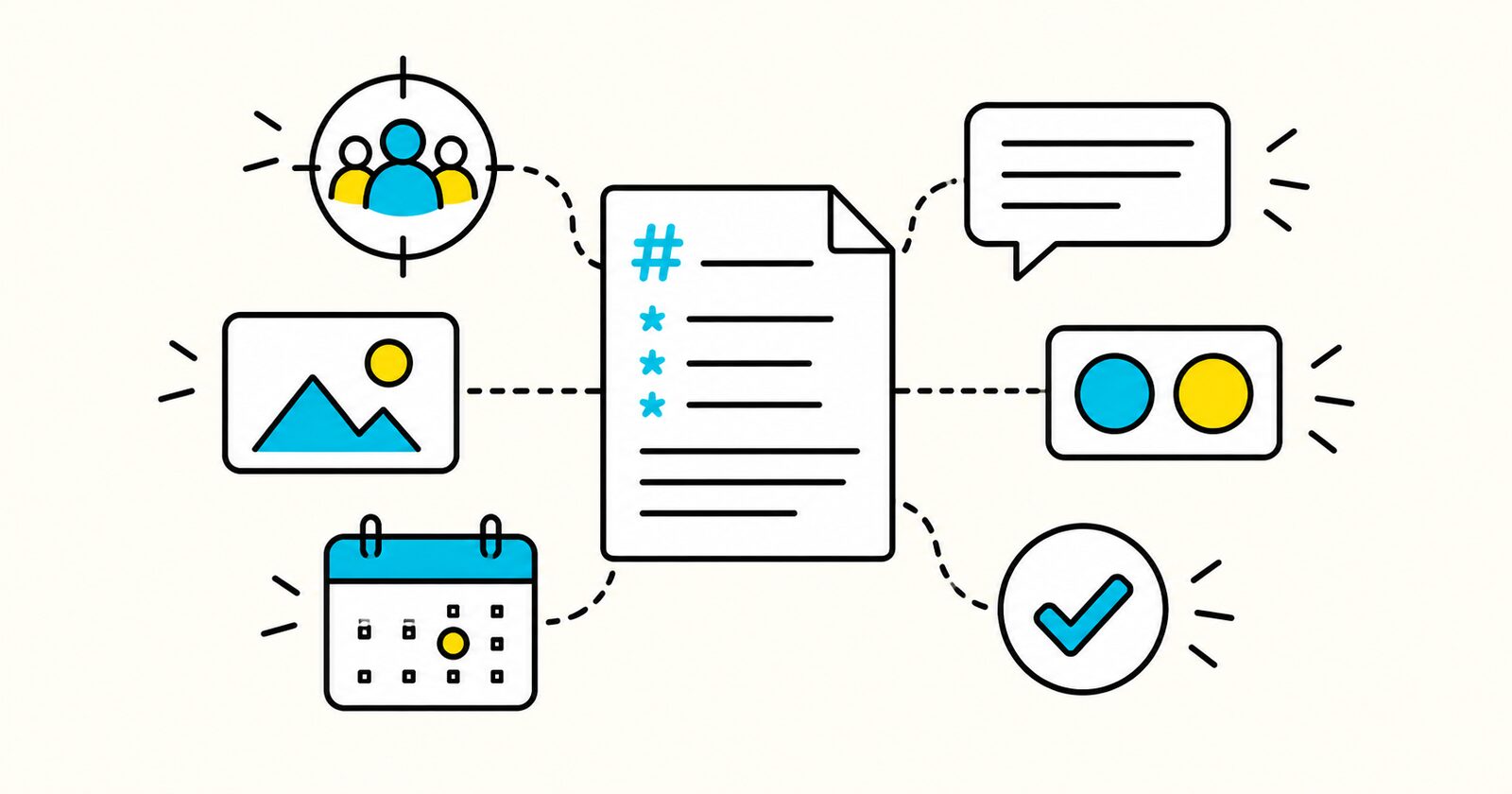
Creative brief at a glance
| Section | Required answer |
|---|---|
| Objective | What should change because the work exists? |
| Audience | Which specific people are we trying to influence? |
| Message | What is the one thing they should remember? |
| Proof | Why should they believe it? |
| Deliverables | What exactly must be produced, in which formats? |
| Constraints | What is mandatory, prohibited, fixed, or out of scope? |
| Approval | Who reviews, who decides, and how many rounds are included? |
Copyable Markdown creative brief
# Creative brief: [Project]

**Brief owner:** [Name]
**Decision owner:** [One approver]
**Version:** 1.0
**Final delivery:** YYYY-MM-DD

## Brief in one sentence
[Create what, for whom, to achieve which outcome, by when?]

## Business objective
- Desired change: [Result]
- Measure and target: [Metric]

## Audience
- Primary audience: [Specific segment]
- Current belief or behavior: [Current state]
- Desired belief or action: [Future state]

## Single-minded message
[One message.]

## Reasons to believe
- [Approved proof point]

## Deliverables
| Deliverable | Channel | Format | Quantity | Owner | Due |
|---|---|---|---:|---|---|
| [Asset] | [Channel] | [Specification] | [Number] | [Name] | YYYY-MM-DD |

## Mandatory elements and constraints
- [Brand, legal, accessibility, budget, or production requirement]

## Review and approval
- Reviewers: [Names]
- Final approver: [One person]
- Included rounds: [Number]
- Feedback deadline: [Date]
- New-scope rule: [Rule]
What should a creative brief include?
A useful brief includes one objective, one primary audience, one central message, credible proof, a deliverables register, mandatory constraints, available inputs, dates, and an approval process.
Link to research and brand guidelines. Do not paste entire background documents into the brief.
Write a measurable objective
“Create an engaging campaign” does not identify the business outcome.
Prefer:
Increase completed trial registrations from paid social traffic from 4.2% to 5.5% by 30 November.
The creative cannot guarantee the result, but the objective tells the team what the work is meant to influence and how performance will be assessed.
Define one primary audience
“Everyone” is not a useful audience. Describe the people whose situation, need, and current belief matter to this project.
Keep demographic details only when they change the message or delivery. Behavior, context, motivation, and evidence are usually more useful than a decorative persona.
Use one central message
A single-minded message is not the final headline. It is the proposition the work must communicate.
If three messages have equal priority, reviewers will favor different ones and the final asset may communicate none clearly.
Specify deliverables precisely
Name the channel, format, dimensions, duration, quantity, language, accessibility requirement, owner, and due date where relevant.
“Social assets” is ambiguous. “Three 1080 × 1350 Instagram feed variants with alt text and editable source files” is testable.
Fix approval before the first draft
Many creative projects fail in review rather than production.
Name one final approver. List the reviewers and the topics they review. Define the number of rounds, feedback location, deadlines, and what counts as new scope.
Feedback can come from several specialists, but the project needs one consolidated direction.
Completed creative brief example
## Objective
Increase completed webinar registrations from the email audience from 2.8% to 4% by 20 November.

## Audience
Operations managers at 50–250-person companies who still build weekly reports manually.

## Single-minded message
Turn the same weekly inputs into a ready-to-share report without rebuilding the document.

## Deliverable
| Deliverable | Channel | Format | Quantity | Due |
|---|---|---|---:|---|
| Registration email hero | Email | 1200 × 600 PNG, under 200 KB, alt text | 2 | 2026-10-12 |
The audience, message, and deliverable are specific enough for the creative team to begin without guessing.
Creative brief versus project brief
A project brief defines the business problem, goal, scope, deliverables, owners, constraints, and approval for a project.
A creative brief goes deeper into audience, message, reasons to believe, tone, asset specifications, and creative review. A large campaign may use both.
Common creative-brief mistakes
- Using vague adjectives such as “premium” without explaining what they mean.
- Naming several primary audiences.
- Treating a list of features as the message.
- Omitting asset formats and quantities.
- Adding legal or accessibility requirements after design begins.
- Allowing many reviewers but naming no final approver.
- Leaving revision rounds and scope-change rules undefined.
- Turning the brief into a long strategy document nobody rereads.
Creative brief FAQ
How long should a creative brief be?
Many briefs should fit on one or two pages. Link to supporting research and guidelines rather than copying them. Complexity, regulation, and deliverable count may require more detail.
Who writes the creative brief?
The owner may be a marketer, strategist, account lead, product manager, or client. It should be completed with the people who own the objective, audience evidence, deliverables, and approval.
Who approves the brief?
One named decision owner should approve the direction before production. Specialist reviewers can confirm legal, brand, accessibility, or channel requirements.
Is a creative brief the same as a design brief?
A design brief is a creative brief focused on a design deliverable. The core structure remains similar, but specifications and review criteria become design-specific.
Should the template include visual references?
Yes, when each reference explains a useful principle. Do not add a mood board without stating what should be learned from it and what should not be copied.
Related templates
- Project brief template
- Product requirements document template
- Project plan template
- Decision log template
- All Markdown templates