
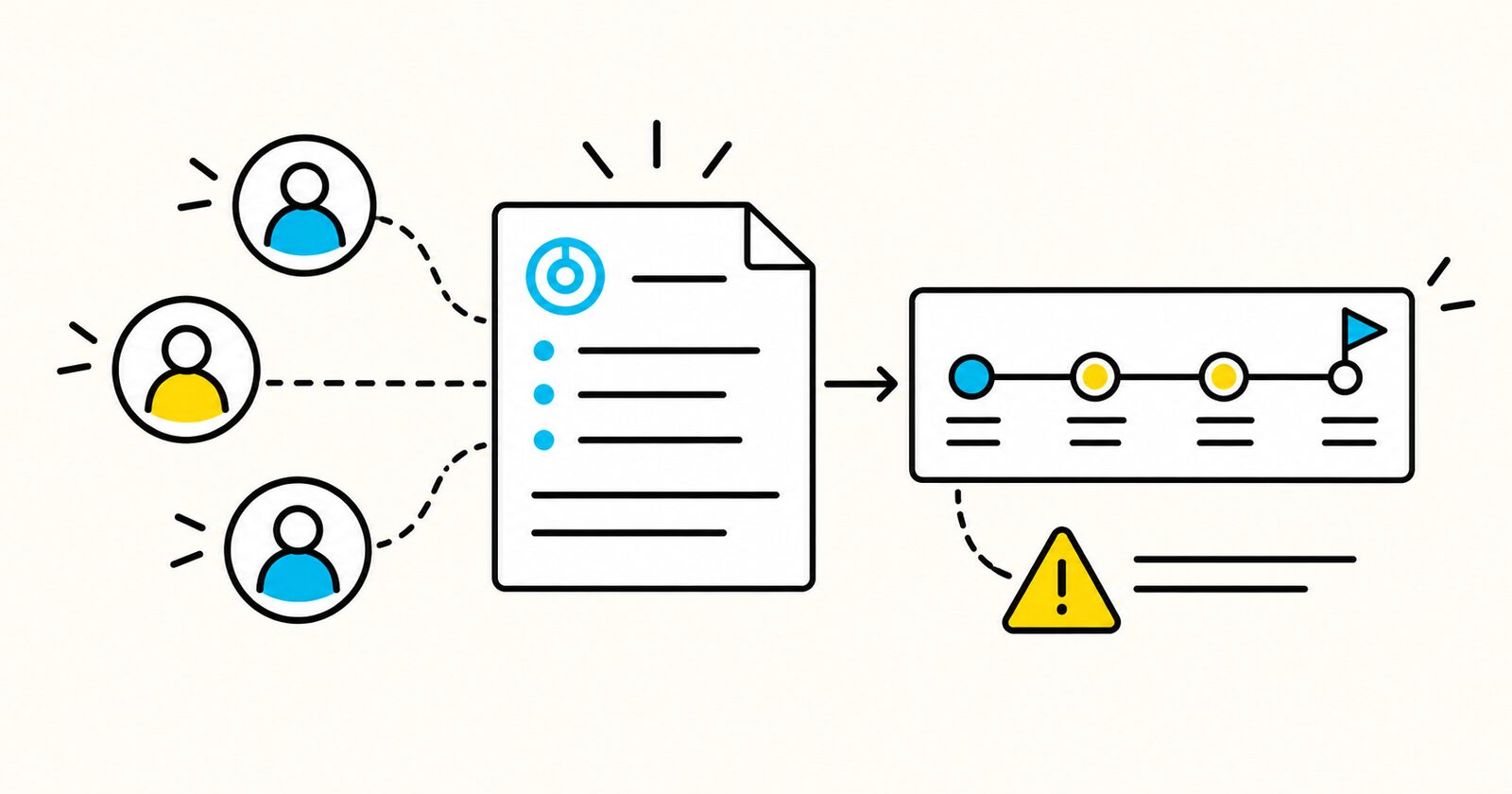
A kickoff should not merely present a finished plan. It should expose missing owners, unresolved assumptions, and decisions that could delay the work.
Project kickoff meeting at a glance
| Item | Recommendation |
|---|---|
| Best time | After authorization and before coordinated delivery begins |
| Typical duration | 45–90 minutes, depending on project size |
| Core attendees | Sponsor, project owner, workstream owners, required decision makers |
| Required outputs | Confirmed scope, owners, risks, communication rules, decisions, actions |
| Pre-read | Approved brief, business case, requirements, research, or proposal |
Copyable project kickoff template
# Project kickoff: [Project name]

**Date and time:** YYYY-MM-DD, [time zone]
**Facilitator:** [Name]
**Sponsor:** [Name]
**Project owner:** [Name]

## Desired meeting outcome
[What everyone should understand, decide, or own by the end.]

## Agenda
| Time | Topic | Owner | Required output |
|---:|---|---|---|
| 5 min | Context and purpose | [Name] | Shared problem statement |
| 10 min | Objectives and measures | [Name] | Confirmed outcomes |
| 10 min | Scope and exclusions | [Name] | Agreed boundaries |
| 10 min | Roles and decisions | [Name] | Named owners |
| 10 min | Milestones and risks | [Name] | Initial delivery path |
| 5 min | Actions and close | [Name] | Actions with dates |

## Objectives and success measures
| Objective | Measure | Baseline | Target | Date |
|---|---|---:|---:|---|
| [Objective] | [Metric] | [Value] | [Value] | YYYY-MM-DD |

## Scope
### In scope
- [Item]
### Out of scope
- [Item]

## Roles and decision rights
| Area | Accountable owner | Contributors | Approver or escalation |
|---|---|---|---|
| [Workstream] | [Name] | [Names] | [Name] |

## Risks, assumptions, and open questions
| Type | Item | Impact | Owner | Review |
|---|---|---|---|---|
| Risk | [Event] | [Consequence] | [Name] | YYYY-MM-DD |

## Actions
- [ ] [Action] · **Owner:** [Name] · **Due:** YYYY-MM-DD
What should a project kickoff cover?
A useful kickoff answers these questions:
- Why does the project exist now?
- What measurable result defines success?
- What is explicitly in and out of scope?
- Who owns each workstream and final decision?
- Which dates, dependencies, and constraints matter first?
- What could prevent success?
- Where will the team communicate and record decisions?
- What must happen immediately after the meeting?
If the approved project brief already answers a question, confirm it rather than reading the entire document aloud.
Prepare before the meeting
Send a concise pre-read
Share the project brief, decision request, or requirements early enough for attendees to identify gaps. Mark which information is approved and which remains open.
Invite decision makers, not spectators
Invite people who own work, supply a dependency, approve a boundary, or need to make a decision. Send an outcome summary to people who only need awareness.
Draft the difficult sections
Do not start with blank scope, roles, or milestones. A draft gives the group something specific to confirm or change.
Suggested 60-minute kickoff agenda
| Time | Topic | Result |
|---|---|---|
| 0–5 | Purpose and desired outcome | Shared reason for the meeting |
| 5–15 | Problem, objective, and measures | Confirmed success definition |
| 15–25 | Scope and deliverables | Written inclusions and exclusions |
| 25–35 | Roles and decision rights | One accountable owner per area |
| 35–45 | Milestones and dependencies | Initial delivery sequence |
| 45–55 | Risks, assumptions, and questions | Owners and review dates |
| 55–60 | Read-back and actions | Named actions with dates |
For a large program, use the meeting to confirm governance and immediate decisions. Detailed workstream planning can follow separately.
Completed kickoff example
## Objective
Move all customer help articles to the new platform by 30 November while preserving indexed URLs and keeping launch-week 404 responses below 0.5%.

## Scope
### In scope
- 120 published help articles
- Redirect mapping and launch QA

### Out of scope
- Rewriting article content
- Translating new languages

## Action
- [ ] Priya provides the final URL inventory · **Due:** 2026-10-05
The example states the outcome, quality threshold, scope boundary, and first dependency.
Project kickoff versus project plan
A project plan is the maintained control document for scope, deliverables, milestones, owners, risks, and communication.
The kickoff is the meeting that aligns the people responsible for executing that plan. Its notes should link to the plan rather than becoming a second competing version.
Common kickoff mistakes
- Presenting for most of the meeting and leaving no time for decisions.
- Describing the vision without defining success measures.
- Omitting the out-of-scope list.
- Naming contributors but no accountable owners.
- Recording risks without owners or review dates.
- Inviting too many observers.
- Ending without reading back actions and decisions.
Project kickoff FAQ
When should a project kickoff happen?
Hold it after the initiative is authorized and enough information exists to discuss scope, ownership, and near-term milestones. Do it before cross-functional delivery begins.
Who should attend?
Include the sponsor or delegate, project owner, workstream owners, key dependency owners, and anyone whose approval can block the next stage.
How long should a kickoff meeting be?
Many projects fit into 60 minutes. Use less time for a small, well-defined project and more for a complex program with material decisions.
What is the most important kickoff output?
A written definition of success and one accountable owner for every major workstream. The action list should also name immediate next steps and dates.
Should a kickoff include team-building activities?
Only when they serve the meeting’s purpose and team context. Do not displace decisions about scope, ownership, risks, and working agreements.