
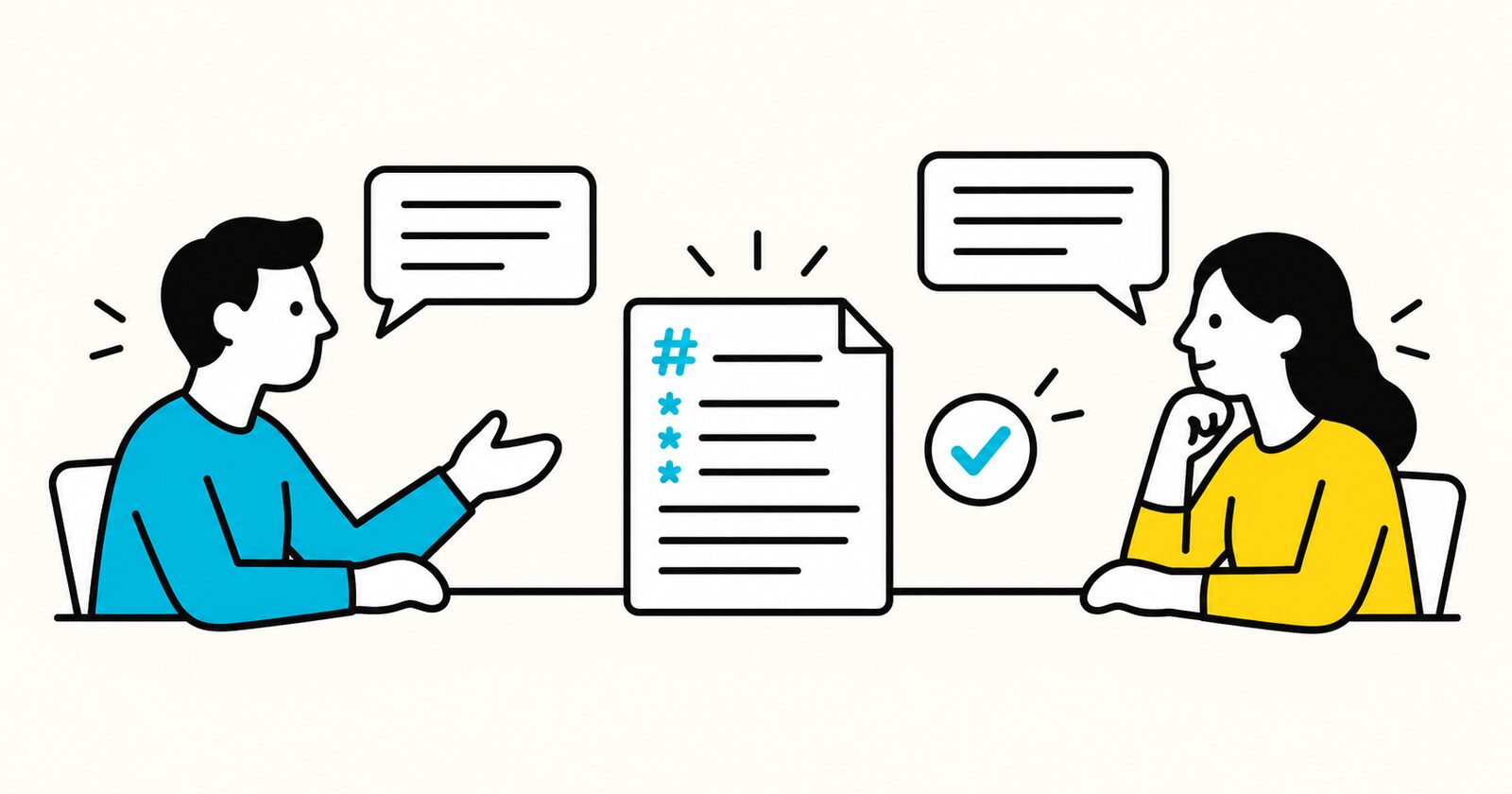
The best one-on-one notes are not a status report or a private manager monologue. Both people should be able to add topics, record commitments, and revisit them at the next meeting.
One-on-one meeting template at a glance
| Item | Recommendation |
|---|---|
| Best for | Recurring manager and team-member conversations |
| Typical cadence | Weekly or every two weeks, adapted to need |
| Typical length | 30–60 minutes |
| Core sections | Check-in, previous actions, priorities, two-way feedback, growth, next actions |
| Shared ownership | Both participants add agenda items |
| Keep elsewhere | Formal HR records, highly sensitive health details, and disciplinary documentation |
Copyable Markdown one-on-one template
# One-on-one meeting: [Manager] and [Team member]

**Date:** YYYY-MM-DD
**Next meeting:** YYYY-MM-DD

## Check-in
- Energy or workload: [Context]
- What is taking most of your attention?

## Follow-up from the previous meeting
| Commitment | Owner | Due | Status | Note |
|---|---|---|---|---|
| [Action] | [Name] | YYYY-MM-DD | Open | [Update] |

## Wins and progress
- [Progress, result, or learning]

## Priorities and blockers
| Priority or blocker | Why it matters | Support needed | Owner |
|---|---|---|---|
| [Topic] | [Impact] | [Specific help] | [Name] |

## Team member topics
1. [Topic]

## Manager topics
1. [Topic]

## Feedback
### Feedback for the team member
- **Observation:** [Specific behavior or result]
- **Impact:** [Effect]
- **Next step:** [Continue, change, or try]

### Feedback for the manager
- [What would make the manager or team more effective?]

## Growth and career
- Goal: [Goal]
- Progress evidence: [Example]
- Opportunity or support needed: [Action]

## Actions before the next meeting
- [ ] [Action] · **Owner:** [Name] · **Due:** YYYY-MM-DD

## Topics to revisit
- [Topic]
The downloadable version also includes decision tracking, a more detailed feedback structure, and a confidentiality reminder.
What should a one-on-one meeting include?
A useful one-on-one should include six things:
- a short personal or workload check-in;
- follow-up on commitments from the previous meeting;
- employee-led priorities, problems, and questions;
- manager-led context or coaching;
- feedback in both directions;
- actions with owners and dates.
Career development does not need to fill every meeting, but it should appear often enough that urgent work does not permanently displace longer-term growth.
How to use the template
Add topics before the meeting
Keep the document shared. Both people should add topics as they arise instead of trying to remember everything during the call.
Put the team member’s topics before the manager’s topics. This reduces the chance that project updates consume the entire meeting.
Review old commitments first
Start by checking the actions from the previous one-on-one. If the same commitment repeatedly moves forward, identify the missing decision, time, or authority instead of copying it again.
Record observations, not labels
Useful feedback identifies a specific behavior or result, explains its effect, and names the next step.
“The update arrived after the client meeting, so the team could not correct the numbers” is more actionable than “communication needs improvement.”
End with a read-back
Read the decisions and actions aloud. Every action needs one owner and a date. If both people appear as the owner, neither person may feel accountable.
One-on-one questions that produce useful answers
Use only the questions relevant to the current conversation.
Work and priorities
- What is taking more time than it should?
- Which decision or dependency is slowing you down?
- What should we stop, simplify, or move?
Manager support
- What could I do differently to make your work easier?
- Where do you need context, authority, or an introduction?
- Is there feedback I have delayed giving you?
Growth
- Which recent task stretched a skill you want to develop?
- What responsibility would you like to try next?
- What evidence would show progress toward your goal?
Team health
- Where is collaboration working well?
- Where is ownership unclear?
- What are people discussing privately that the team should address openly?
Completed one-on-one example
## Priorities and blockers
| Priority or blocker | Why it matters | Support needed | Owner |
|---|---|---|---|
| Customer research synthesis is delayed | Friday roadmap review needs evidence | Move two reporting tasks and confirm an analyst for Thursday | Aisha and Ken |

## Feedback for the manager
- Send roadmap changes in the shared channel instead of only mentioning them in leadership meetings.

## Actions before the next meeting
- [ ] Ken confirms analyst support · **Due:** 2026-10-03
- [ ] Aisha publishes the first research summary · **Due:** 2026-10-06
The example identifies the consequence, the support required, and the next action. “Research is blocked” would not be enough.
One-on-one meeting notes versus performance records
One-on-one notes support an ongoing working relationship. A formal performance record supports an organization’s approved HR process.
Do not assume a shared Markdown file is the correct place for sensitive medical, disciplinary, compensation, or employee-relations details. Follow the organization’s access, retention, and privacy requirements.
Common one-on-one mistakes
- Turning the meeting into a project status update.
- Allowing only the manager to set the agenda.
- Asking broad questions without follow-up.
- Recording personal details that do not belong in a shared note.
- Giving feedback as a personality label rather than an observable example.
- Ending without owners and dates.
- Keeping old actions visible without discussing why they remain open.
One-on-one meeting FAQ
How often should one-on-one meetings happen?
Weekly or every two weeks works for many teams, but cadence should reflect the employee’s needs, role, and current change. Consistency matters more than following one universal schedule.
Who owns the one-on-one agenda?
Both participants. The team member should have protected space for their topics, while the manager adds context, coaching, and feedback.
Should one-on-one notes be private?
The working note is normally shared by the two participants. Access rules vary by organization. Formal or sensitive records may need an approved HR system instead.
What should not go into a one-on-one?
Avoid turning it into a task-by-task status meeting. Move detailed planning to the relevant project system and preserve the one-on-one for support, feedback, priorities, and development.
Can this template be used for remote meetings?
Yes. A shared Markdown file works especially well asynchronously because both people can add topics before the call and review actions afterward.
Related templates
Sources
- Gallup: Managers account for differences in employee engagement
- CIPD: Performance feedback factsheet
The structure is practical guidance, not legal or human-resources advice. Apply your organization’s policies and local requirements.