
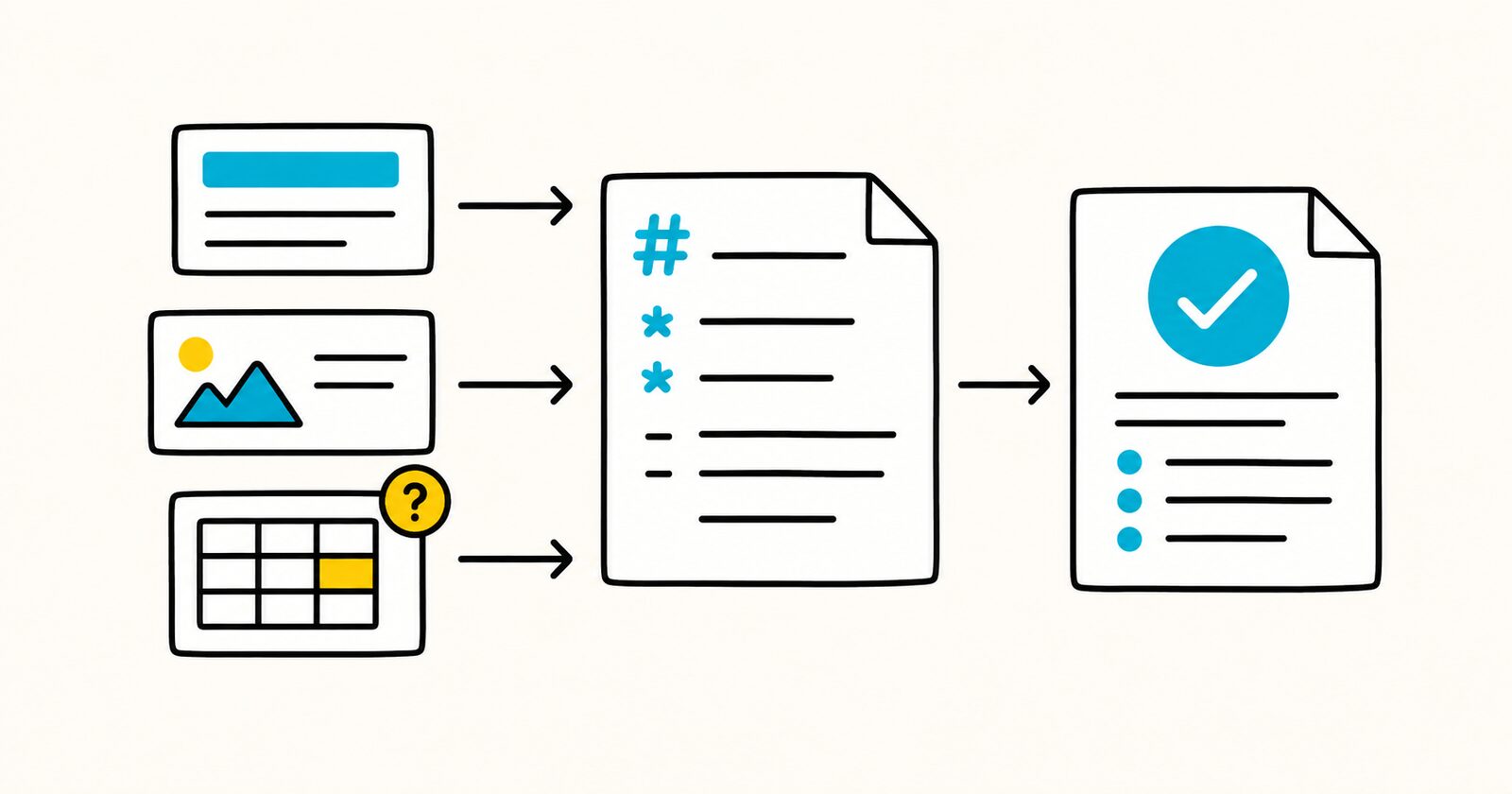
Research notes key facts
- Begin with an answerable question and the decision it supports.
- Record the method and boundaries so another person can assess coverage.
- Separate a source’s claim from your interpretation.
- Save page, section, timestamp, table, or query details needed to find evidence again.
- Record conflicting evidence and uncertainty instead of forcing a clean answer.
Copyable Markdown research notes template
# Research notes: [Question or topic]

**Researcher:** [Name]
**Date started:** YYYY-MM-DD
**Last updated:** YYYY-MM-DD
**Status:** In progress

## Research question
[Write one answerable question.]

## Decision this research supports
[State how the findings will be used and by whom.]

## Scope

### Included
- [Population, market, system, or time period]

### Excluded
- [Boundary]

## Method
[Search terms, databases, interviews, experiments, sample, and limitations.]

## Source log

| Source | Type | Date | Relevance | Reliability notes |
|---|---|---|---|---|
| [Title](URL) | Primary/Secondary | YYYY-MM-DD | [Why useful] | [Method and limitations] |

## Evidence notes

### [Source or theme]
- **Claim:** [What the source supports]
- **Evidence:** [Paraphrase, data, or short permitted quotation]
- **Location:** [Page, section, timestamp, or table]
- **Interpretation:** [Your analysis]

## Findings
1. **[Finding]:** [Synthesis supported by evidence.]

## Conflicting evidence
- [Disagreement and effect on confidence]

## Limitations and unknowns
- [Missing data, bias, uncertainty, or transferability limit]

## Conclusion
[Answer the question and state confidence.]

## Search log

| Date | Query or method | Result |
|---|---|---|
| YYYY-MM-DD | [Query] | [What changed or was found] |
Cite evidence consistently
Use links for public sources and stable internal references for private material. Keep quotations short and record the exact location. A source log is not proof by itself; the finding should show how the evidence supports the conclusion.
Separate evidence from interpretation
Write what the source actually supports before adding your explanation. Mark inference, estimate, and opinion explicitly. When two sources repeat the same underlying report, do not count them as independent confirmation.
Prefer primary sources for specifications, laws, product behavior, and original research. Secondary sources can help discover context or disagreement, but verify material claims against the primary evidence when possible.
Make the research reproducible
Save the date, query, filters, database, sample, and exclusion criteria. Record negative searches when they affect confidence. For changing web content, save an approved archive or capture enough citation detail to identify the version consulted.
Finish with an answer to the research question, a confidence statement, the main limitations, and the next evidence that would most reduce uncertainty.
Completed research-note example
Question: Does the current Markdown renderer support footnotes consistently across desktop and web?
Finding: Desktop version 4.8 renders the tested footnote syntax, while the web editor displays the marker as plain text. Confidence is high for the tested versions but does not cover mobile or alternative syntax. Evidence includes the test document, screenshots, application versions and test date.
This format distinguishes the observed result from the coverage limit. It avoids the unsupported conclusion that “Markdific supports footnotes everywhere.”
Research notes FAQ
What belongs in a source log?
Record enough information to find and evaluate the source again: title, URL or identifier, publication date, access date when relevant, source type and reliability limitations.
Should research notes include quotations?
Use short quotations only when exact language matters. Add page, section or timestamp details and keep your interpretation separate.
How do I handle conflicting sources?
Record the disagreement, compare methods and dates, and explain which evidence is more applicable. Do not hide conflicting evidence to make the conclusion appear certain.